
Net Zero by 2050
October 2026 Update
Our Commitment
Harvard University has long worked to address the risks of climate change. In 2020, it expanded these efforts by committing to achieve net zero greenhouse gas (GHG) emissions for its endowment portfolio by 2050 (the Net Zero Commitment).
Recognizing the economic threat posed by climate change and the imperative for decisive, near-term action, HMC commits to:
- Achieve the Net Zero Commitment by drawing on the best available scientific knowledge and standards established by the United Nations’ Intergovernmental Panel on Climate Change (IPCC);
- Integrate the Net Zero Commitment into its comprehensive approach to sustainability management, in a manner consistent with its fiduciary obligation to manage risk prudently and achieve targeted investment returns;
- Collaborate with current and prospective asset managers to prioritize measurable GHG emissions reductions in the real economy; and
- Engage with peer institutions that have adopted—or are actively considering—comparable net zero commitments.
Climate change represents a material long-term investment risk. HMC’s response is to measure climate change rigorously, reduce its operational footprint, invest in solutions, and continuously improve how it assesses climate-related risks.
Learn more about Harvard University’s climate commitments and sustainability efforts.
Investing in the Climate Transition
HMC is committed to advancing the transition to a low-carbon economy while preserving the strong, long-term, risk-adjusted returns that Harvard University requires. HMC recognizes that reducing GHG emissions and driving robust global economic development are complementary goals—each requiring a disciplined response to rapidly evolving market and policy environments.
HMC’s climate transition strategy focuses on investments that enable the shift to a lower-emission economy. HMC has deployed capital into funds and companies that actively reduce greenhouse gas emissions, improve energy efficiency, expand lower-carbon energy production, and strengthen climate resiliency.
Many climate technologies require significant capital to scale from research and development through commercial deployment. Private capital plays an important role in financing this growth, particularly in sectors where technological innovation, infrastructure investment, and long development timelines may limit access to traditional public markets.
HMC engages actively with external managers on climate transition, encouraging them to identify sector-specific risks and develop scalable solutions within their respective industries. HMC also monitors the potential implications of shifting regional and global policy frameworks, and the competition for talent across the hard technology sector.
Traditional emissions metrics primarily measure historical emissions. For investments intended to accelerate climate transition, HMC, working with Rho Impact, also evaluates the potential future emissions reductions that technologies could enable as they scale. These assessments model the GHG emissions a given technology or solution could prevent or reduce relative to a defined baseline or incumbent technology. This approach is informed by pre-investment methodology guidance developed by Project Frame—a nonprofit program convened by Prime Coalition.
Prior Climate Reports measured this activity by reporting transition strategy and fossil fuel exposures as a percentage of the total endowment. HMC believes the forward-looking analysis described above offers a clearer view of both potential climate impact and commercial opportunity.
As methodologies continue to evolve, HMC expects to refine these approaches while maintaining its focus on long-term investment returns and prudent risk management.
Potential Climate Impact
Portfolio and category estimates, 2025–2035
MTCO₂e
Swipe across the chart to see every year.
Hover or tap the chart to explore a year. The portfolio aggregate is shown by default. Select a category to explore its estimates, or All categories to compare them. The vertical scale adjusts.
All forward-looking assessments are based on significant assumptions. A technology’s status as a “solution” depends on the industry context where it is deployed and its application. Such assessments are only estimates and actual results will vary. Despite this, HMC believes forward-looking estimates in this table provide a better lens into the climate impact in its transition strategy than backward-looking data.
Measuring Portfolio Emissions
The endowment’s are measured using company-level Scope 1 and 2 data. HMC generally follows the Partnership for Carbon Accounting Financials (PCAF) standards for calculating financed emissions. Ultimately, HMC expects to adopt an approach and methodology tailored to its unique investment program.
HMC maintains active dialogue with external asset managers (GPs) on climate strategy and net zero alignment. HMC also works with GPs to improve emissions data coverage, enabling more accurate measurement of the portfolio’s financed emissions. Improving data coverage and quality are essential to both tracking progress toward net zero and deepening HMC’s understanding of the climate implications of specific investment strategies.
This work has demonstrated that:
- GP-reported data substantially improves overall data quality. By contrast, third-party models rely on emissions data from public company proxies, rather than company-specific information. Comparing these two sources has revealed material differences that helped HMC refine its approach by prioritizing GP-reported data.
- Industry initiatives focused on improving the consistency and comparability of reported emissions data have materially aided HMC’s effort to assess portfolio emissions over time. For example, in private equity, the ESG Data Convergence Initiative (EDCI) has meaningfully advanced emissions data collection and dissemination across the industry, with particular benefit for the “buyout” segment of the asset class. HMC joined the EDIC in 2022.
Climate Scenario Analysis
In 2026, HMC partnered with a third-party, Ortec Finance, to conduct a climate scenario analysis for the endowment portfolio. Climate scenario analysis is a “what-if” exercise. Unlike economic scenarios, which are probabilistic projections of risk and return, climate scenarios are narrative-based pathways that translate plausible future climate outcomes into quantitative impacts. Climate scenario analysis isolates the effect of climate risk by showing impacts relative to a baseline. The results show how transition risk, physical risk, and market repricing risk could change expected outcomes compared to a no-climate-shock baseline.
The framework incorporates three main sources of climate risk:
- Transition risks and opportunities from policy and technology changes;
- Chronic and acute physical risks from warming, extreme weather, productivity loss, and damage events; and
- Market pricing risks, where financial markets abruptly reprice future climate losses or stranded asset risks.
HMC implemented a top-down approach—evaluating climate impacts through macroeconomic and financial variables, including GDP, inflation, interest rates, currencies, listed equities, sovereign bonds, credit, private assets, real estate, and total portfolio returns. This approach captures long-term economy-wide systemic effects, network effects, and cross-asset dynamics that are difficult to capture through bottom-up security-level analysis alone.
Ortec’s five climate scenarios analyzed:
- Net Zero is an orderly, ambitious transition scenario with a projected temperature outcome of approximately 1.6°C. It assumes rapid low-carbon policy action, technology transition, climate adaptation, and relatively smooth market adjustment.
- Net Zero Financial Crisis also reaches approximately 1.6°C but assumes a disorderly financial-market reaction. In this scenario, sudden divestments and repricing of high-emitting assets trigger market dislocation, stranded assets, and a sentiment shock.
- Delayed Net Zero reaches approximately 1.9°C and assumes limited additional action until 2030, followed by a sudden and ambitious policy response. The delayed transition creates both higher physical risks and a sharp transition shock when markets price in the new policy regime.
- Limited Action reaches approximately 2.8°C. In this pathway, governments fall short of meeting emissions targets and Paris-aligned goals. Transition risks are less abrupt than in a disorderly net zero pathway, but physical risks become severe.
- High Warming reaches approximately 3.8°C and is the most severe scenario. It assumes no further climate policy action beyond economic transition trends, with catastrophic chronic and acute physical risks, including non-linear damage and tipping-point effects.
Key Findings
The scenario analysis suggests that the greatest long-term investment risk arises not from an orderly transition to a lower-carbon economy, but from delayed climate action and higher-warming outcomes. While rapid policy changes may create short-term market disruptions, the analysis indicates that the cumulative effects of physical climate risk become increasingly significant over longer investment horizons. Over the next five years, estimated cumulative impacts range from approximately 0% under the Net Zero scenario to -14% under the Delayed Net Zero scenario, suggesting that abrupt policy shifts, stranded asset repricing, and changing market sentiment could create meaningful near-term downside risk.
Over a 15-year horizon, physical climate risks become the dominant driver of portfolio outcomes. Estimated cumulative impacts range from -1% under the Net Zero scenario to -45% under the High Warming scenario, highlighting the increasing economic consequences of higher-warming pathways and reinforcing the importance of adaptation, resilience, and geographic diversification.
Earlier decisions to underweight several high-emitting sectors—stemming from the initial 2020 commitment—reduced exposure to some of the sectors most negatively exposed to climate risk across the scenarios analyzed.
The analysis also suggests that Harvard’s broadly diversified portfolio provides resilience across a wide range of scenarios.
HMC Carbon-Neutral Operations
HMC has maintained carbon neutral operations since fiscal year 2022. By doing so, HMC holds itself to the same standards it asks others and aligns its operations with Harvard University’s climate commitments.
HMC actively pursues opportunities to further reduce its operational emissions, drawing on applicable state and local sustainability initiatives to inform its approach. Staff work closely with building management to assess sustainability plans for shared tenant services, monitor energy consumption data, and identify efficiencies within office infrastructure. HMC also reviews employee practices and procurement decisions for additional opportunities to minimize its environmental footprint.
Emissions by category
Each area represents its share of total emissions.
Emissions by scope
Share of total greenhouse gas emissions.
HMC’s operational footprint as of 6/30/25
Where emissions cannot be fully abated, HMC purchases and retires voluntary carbon dioxide removal (CDR) credits from partners held to the most rigorous standards of measurement, reporting, and verification.
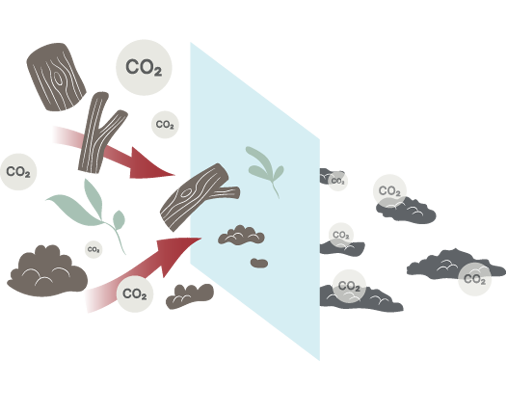
BIOCHAR
Processing biomass into charcoal (“biochar”) to store carbon in soils
100+ YEARS
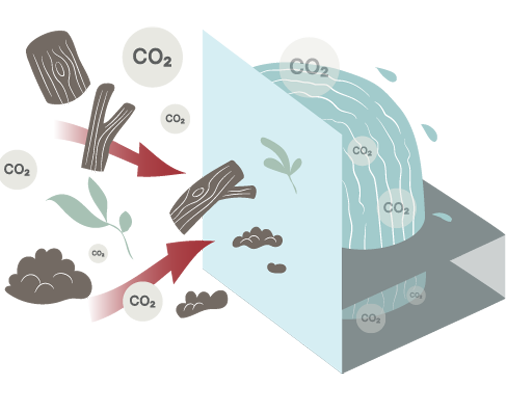
BIOMASS CARBON REMOVAL AND STORAGE (BICRS)
Converting biomass into carbon-rich bio-oil with geological storage
1,000+ YEARS
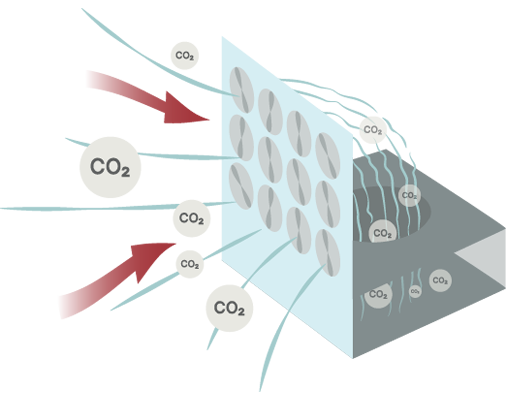
DIRECT AIR CAPTURE (DAC)
Capture CO₂ from the ambient air with geological storage
1,000+ YEARS
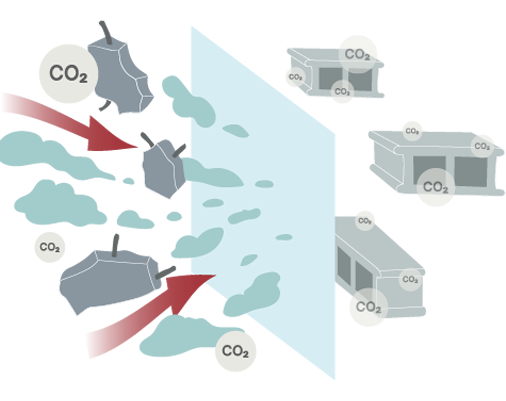
MINERALIZATION
Demolished concrete used to store captured CO₂ and provide recycled carbon-rich concrete for new construction
1,000+ YEARS